Red Light Therapy for Hair Restoration: Why It’s Suddenly Everywhere
Hair loss is one of those things people don’t always talk about openly—but it comes up in consults all the time.
Not dramatically. Not urgently. More like:
“I feel like my hair isn’t what it used to be.” “My ponytail is thinner.” “I can see more of my scalp in photos.”
And for a long time, the options felt… limited. Either you committed to medications, or you just kind of accepted it.
That’s why red light therapy for hair restoration has gotten so much attention lately. It sits in this interesting middle ground—non-invasive, low-risk, but actually backed by real biology.
So let’s talk about it properly. What it is, what it does, and whether it’s something you should actually consider.
First: what red light therapy is doing to your scalp
Red light therapy (you’ll also hear “low-level laser therapy” or LLLT) uses specific wavelengths of light—usually in the red and near-infrared range—to stimulate cellular activity.
That sounds vague, so here’s the more useful version:
The light penetrates the scalp
It interacts with mitochondria (the energy centers in your cells)
That increases ATP production—basically cellular energy
More energy = better function
In hair follicles, that translates to:
Increased activity in the follicle
Improved blood flow around the follicle
A shift of follicles out of the “resting” phase and back into the growth phase
Hair grows in cycles. Red light therapy isn’t creating brand new follicles—it’s helping the ones you still have behave better.
That distinction matters.
Why LED Therapy is having a moment right now
There’s a reason you’re suddenly seeing red light helmets, caps, and panels everywhere.
A few things came together:
1. People want non-drug options
Medications like minoxidil and finasteride absolutely work for many patients. I still prescribe them, but not everyone wants:
A daily medication commitment
Potential side effects
Something they feel locked into long-term
Red light therapy feels different. It’s non-invasive, no systemic absorption, and for a lot of people, that’s enough to make them more open to trying it.
2. We’re catching hair loss earlier
Patients are coming in sooner now.
Not when there’s obvious thinning, but when things just feel “off.” Less density, more shedding, subtle widening of the part.
That’s actually the ideal time for something like red light therapy to work.
Once follicles are completely gone, we’re having a different conversation (usually about transplant); but when follicles are still there, just underperforming? That’s the sweet spot.
3. The data is… actually decent
This isn’t one of those trendy treatments with zero science behind it.
Multiple clinical studies have shown that low-level laser therapy can:
Increase hair density
Improve hair thickness
Prolong the growth phase of hair
Is it dramatic? No. Is it meaningful, especially early on? Yes.
In aesthetics, that’s often the difference-maker; stacking small, real improvements over time.
What I see in real patients
Let’s take this out of the “study” world and into the clinic.
When red light therapy is working well, patients usually notice:
Less shedding first (this is often the earliest sign)
Then improved texture—hair feels a bit stronger, less fragile
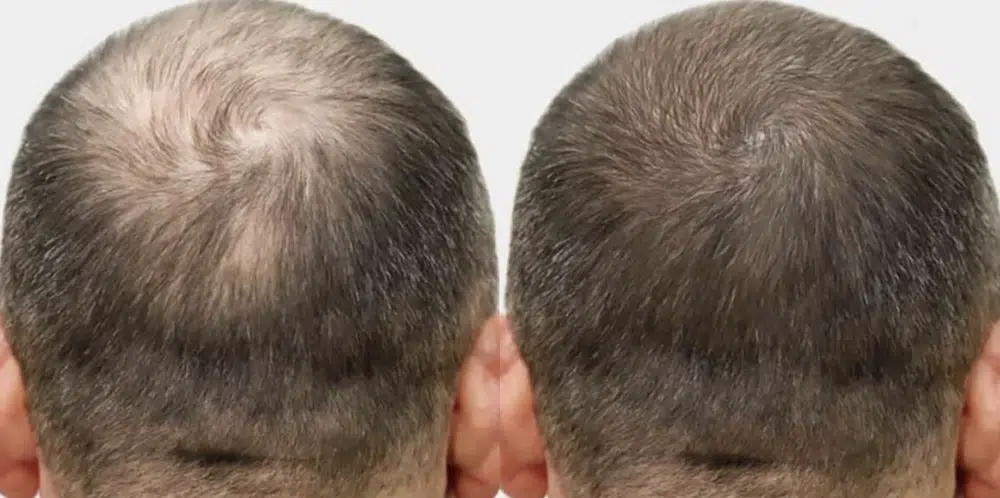
Then gradual density improvement over a few months
It’s subtle. You don’t wake up one day with completely different hair.
It’s more like: “You know what… I don’t see as much scalp anymore.”
Or: “My hairdresser said something.”
That’s usually how it shows up.
Who I think should seriously consider Red Light Therapy
Red light therapy makes the most sense if:
You’re noticing early thinning (not advanced bald areas)
Your ponytail is smaller, but not gone
You’re seeing more scalp at the part or crown
You’ve had increased shedding after stress, illness, or hormonal shifts
You want to support hair growth without jumping straight into medication
It also works really well as part of a combination plan:
With PRP
With medical-grade topicals
With internal support (iron levels, hormones, etc.)
Hair loss is rarely one-dimensional. Treatment shouldn’t be either.
At-home devices vs professional treatment
(this part matters)
I get asked this a lot: “Can I just buy a red light cap online?”
Short answer: yes, you can, but there are differences.
At-home devices:
Lower power (for safety reasons)
Smaller treatment areas
Totally dependent on your consistency
And consistency is where most people fall off.
Professional treatments:
Higher, controlled energy delivery
Full scalp coverage
Structured protocols (we guide frequency and duration)
Often combined with other in-clinic therapies for better results
It’s similar to skincare.
Yes, you can build a routine at home, but sometimes you need in-clinic treatments to actually move things forward.
What to expect if you start
Red Light Therapy is not a one-and-done treatment.
Typical plan:
Multiple sessions per week initially
Then tapering into maintenance
Expect to give it at least 3–4 months before judging results
Hair cycles are slow. That’s just biology.
If someone promises instant results for hair restoration, that’s your cue to be skeptical.
What it won’t do (important)
Red light therapy is not going to:
Regrow hair in completely bald areas
Replace a hair transplant
Override severe hormonal or genetic hair loss on its own
But that doesn’t make it “weak.” It makes it specific.
It’s best at:
Supporting existing follicles
Slowing progression
Improving density and quality over time
Why it should be on your radar
If you zoom out a bit, hair restoration is moving in the same direction as skincare.
Less “fix it when it’s severe.” More “intervene early, support biology, maintain what you have.”
Red light therapy fits that shift really well.
It’s not aggressive. It’s not dramatic. But it’s consistent, low-risk, and builds over time.
And honestly, those are the treatments that tend to age the best because they don’t look like treatment at all.
Final thoughts: red light therapy as part of your plan
If your hair feels different—and you can’t quite explain it, but you know it’s not what it used to be—that’s usually the moment to act.
Not later.
Red light therapy isn’t the only option. But it’s one of the few that sits in that space of:
Evidence-based
Non-invasive
Actually doable long-term
And for a lot of patients, that’s exactly what they’ve been looking for.
If you’re curious whether it makes sense for you, the next step is a proper assessment. Hair loss is nuanced, and the plan should be too.
At Skin Vitality, we specialize in advanced aesthetics, medical-grade treatments and personalized body contouring plans tailored to your unique body, goals, and lifestyle. With over 200 medically trained staff across 14 clinics, and proudly serving Ontario since 1992, we’re Canada’s #1 provider of Botox®, Juvederm®, and CoolSculpting®, and the leading provider of EMSCULPT NEO in Ontario.
Our treatments are clinically overseen by Dr. Ramzan, MD, Medical Director at Skin Vitality Medical Clinic and a board-certified physician. Treatments are performed by licensed nurses, injectors, and technicians.
We don’t believe in one-size-fits-all treatments, we believe in custom transformations backed by medical expertise, proven technology, and trust.